IB Program
The International Baccalaureate Diploma Programme (IBDP)
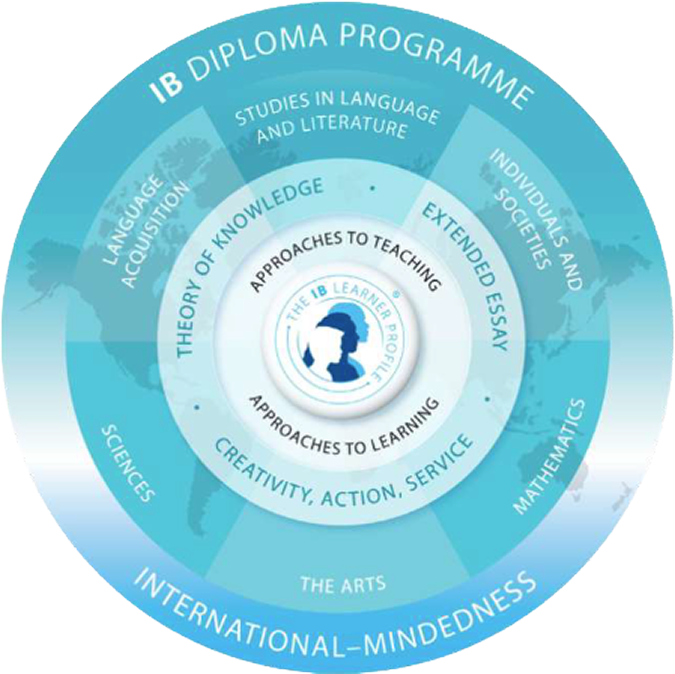
The International Baccalaureate Diploma Programme (DP) is a comprehensive and academically challenging two-year pre-university course for students aged 16 – 19. It is a unique and internationally recognised program whose graduates are welcomed by leading universities worldwide (more about the IB Diploma).

The International Baccalaureate Diploma Programme (IBDP)
The International Baccalaureate Diploma Programme (DP) is a comprehensive and academically challenging two-year pre-university course for students aged 16 – 19. It is a unique and internationally recognised program whose graduates are welcomed by leading universities worldwide. (More about IB diploma – link to IBO site).
Curriculum Overview
Core requirments: all students take part in the three parts of the core
In addition to the core requirements, students study six subject courses. Students select one subject from each of Groups 1-6
Group 1: Language and Literature (Language A)
Arabic A Language & Literature – SL & HL
The Language and Literature course provides students with a critical exploration of 4-6 novels (depending on the level at which the student studies the course) and texts they encounter in their everyday lives, such as ads, social media, and news. Students develop skills of literary and textual analysis, and also the ability to present their ideas effectively. A key aim is the development of critical literacy. In doing so, students also immerse themselves in the Arabic-speaking world, including its culture, traditions, and politics.
English A Language & Literature – SL & HL
The Language and Literature course provides students with a critical exploration of 4-6 novels (depending on the level at which the student studies the course) and texts they encounter in their everyday lives, such as ads, social media, and news. Students develop skills of literary and textual analysis, and also the ability to present their ideas effectively. A key aim is the development of critical literacy. In doing so, students also gain a deeper appreciation of the language’s culture.
Hebrew A Literature – SL & HL
In Hebrew A, students read and analyze a wide variety of literary texts, allowing them to explore Israeli culture on a deeper level. Students also read a some translated texts, exposing them to other cultures around the world and universal themes across time and place. Through this course, students learn to appreciate the artistry of literature, and develop the ability to reflect critically on their reading, presenting literary analysis powerfully through both oral and written communication.
Self-Taught Literature – SL only
The Self-Taught Literature course allows students to study literature in their native language, even if EMIS doesn’t offer a Literature course in that specific language. As part of the course, students are required to find and hire a tutor to meet once a week to study and analyse literature in their native language. Under the guidance of one EMIS’s experienced Literature teachers, students meet once a week to review skills relevant to analysing literature, regardless of the target language. The Self-Taught Literature course allows students to develop their critical analysis, maintain a deep connection with their home culture, and also develop independent study skills that will foster their success both at EMIS and beyond.
Group 2: Language acquisition
Spanish Ab Initio – SL only
The Spanish ab initio course is designed for students who have little or no background in learning the Spanish language. The ab initio course develops students’ proficiency in reading, writing, listening, and speaking and eventually brings them to the B1 level. The course also provides students with a rich understanding of Spanish and Latin American cultures.
English B – HL only
The English B HL course is intended for advanced English language learners, perhaps best fitting students who haven’t studied all of their academic subjects in English before. During orientation, DP1 students take a placement exam to determine which English course is the best fit for them. In English B, students primarily focus on reading and writing non-fiction texts, especially those they would encounter in the real world, though students also read 2 literary texts.
Group 3: Individuals and Societies
Economics – SL & HL
Economics looks to make sense of the world around us, both at a macro scale (that of nations and international bodies) and a micro scale (individual markets or even individual human behaviours). In the course, students examine the choices that consumers, producers, and governments make using models and theories. The Economics course allows students to explore these models and theories, and apply them, using empirical data, through the examination of six real-world issues and current events.
Global Politics – SL & HL
The Global Politics course allows students to develop an understanding of the local, national, international, and global dimensions of political activity, as well as allowing them the opportunity to explore political issues affecting their own lives. It helps students to understand abstract political concepts by grounding them in real world examples and case studies and studies these issues through the four units and lenses of power, sovereignty and international relations, human rights, development, and peace and conflict.
Social & Cultural Anthropology – SL & HL
Social and Cultural Anthropology contributes to a distinctive approach to developing students’ intercultural awareness and understanding. It encourages students to develop the capacity to recognize preconceptions and assumptions of their own social and cultural environments through an exploration of both the familiar and unfamiliar worlds of other people. In studying this course, students will come to appreciate how Anthropology as a discipline contributes to an understanding of contemporary issues, such as war and conflict, the environment, poverty, injustice, inequality and human and cultural rights. The study of Social and Cultural Anthropology offers critical insight into the continuities as well as dynamics of social change and the development of societies, and challenges cultural assumptions.
Business Management – SL & HL
Students learn to analyse, discuss, and evaluate business activities at local, national, and international levels. The course covers a range of organizations from all sectors, as well as the socio-cultural and economic contexts in which those organizations operate. The course covers the key characteristics of business organization and environment and the business functions of human resource management, finance and accounts, marketing and operations management, as well as ethical concerns that businesses and business leaders deal with.
History – SL & HL (offered based on demand)
The course is a world history course based on a comparative, multi-perspective approach to history and focused around key historical concepts such as change, causation, and significance. It involves the study of a variety of types of history, including political, economic, social and cultural, encouraging students to think historically and to develop critical thinking and analytical skills. In this way, the course is a critical exploration of the past.
Philosophy – SL & HL (offered based on demand)
At its heart, Philosophy seeks to answer pressing questions like, “What does it mean to be human? Do we have free will? How do we know if a claim is right or wrong?” As abstract as these questions might seem, the Philosophy course aims to ground these questions and issues in our everyday experiences. The course provides students with tools such as critical and systematic thinking, careful analysis, and construction of arguments and overall develops students’ curiosity and independent thinking.
Group 4: Sciences
Biology – SL & HL
The Biology course provides students with a deep understanding of all living things, from the smallest unit of molecules and cells all the way to the largest scale of ecosystems and the biosphere. As an experimental science, Biology requires not only a theoretical understanding of the subject, but also an awareness of how biologists construct knowledge claims and the limitations of these methods.
Chemistry – SL & HL
The Chemistry course combines academic study with the acquisition of practical and investigational skills while developing creative and rational thinking. Studying chemistry offers numerous benefits and opens a wide range of opportunities for further studies. As an experimental science, chemistry requires not only a conceptual understanding of the subject, but also an awareness of how chemists construct knowledge claims and the limitations of these methods.
Computer Science – SL & HL
Computer Science takes both a hands-on and theoretical approach to the world of programming. Students learn various languages and programming, eventually developing their own applications or websites. In doing so, students develop problem-solving skills and their technical abilities. The course is open to students with and without previous experience in Computer Science.
Physics – SL & HL
Physics is the most fundamental of the experimental sciences, as it seeks to explain the universe itself from the very smallest particles to the vast distances between galaxies. The Physics course involves a mathematical approach to the subject content to ensure an understanding of models, theories, and laws. While studying Physics, students have the opportunity to develop their data analysis and experimental skills.
Environmental Systems & Societies -SL & HL
Environmental systems and societies (ESS) is an interdisciplinary course that combines a mixture of methodologies, techniques, and knowledge associated with both the sciences and humanities. Through studying ESS, students will gain an in-depth understanding of the interrelationships between environmental systems and societies–one that enables them to adopt an informed personal response to the wide range of pressing environmental issues that they will inevitably come to face.
Depending on the schedule for the school year, Environmental Systems & Societies can also count as a Group 3 subject. However, it often only counts as a Group 4 science based on the timetable.
Group 5: Mathematics
Math Applications & Interpretations – SL only
The Mathematics Applications and Interpretation SL course is designed for students who want to develop a strong understanding of mathematics with an emphasis on its practical application. The course focuses on using mathematics to solve real-world problems, from interpreting data and modelling to applying statistical techniques.
This course is especially suited to students who may have found more abstract mathematics challenging but who enjoy exploring how mathematics can be applied to everyday situations. It provides an excellent foundation for further study in subjects such as biology, psychology, human sciences and business. During orientation, DP1 students take a placement exam to determine which Math course is the best fit for them.
Math Analysis and Approaches – SL & HL
The Mathematics Analysis and Approaches course takes a more theoretical and abstract approach to mathematics. The course develops students’ ability to apply mathematical methods to both real-world and abstract problems, with a focus on logical reasoning, problem-solving, and generalisation. Both courses provide students with a thorough preparation in the field, though the Higher Level version of the course goes more in depth, covering material that many students study in university.
This course is well suited to students who enjoy analytical thinking and who may go on to study subjects with a strong mathematical background at university. During orientation, DP1 students take a placement exam to determine which Math course is the best fit for them.
Group 6: Arts
Visual Arts – HL only
*Group 6 is optional; students can choose to study an additional subject from Groups 3 or 4.
In Visual Arts, students experiment with a variety of mediums to create their own collection of art pieces, and in doing so, develop their artistic abilities and critical thinking and analytical skills. Students also immerse themselves in the art world throughout Israel, regularly taking trips to museums and meeting with artists throughout the country to better understand the field and unique perspectives of artists.
FAQ
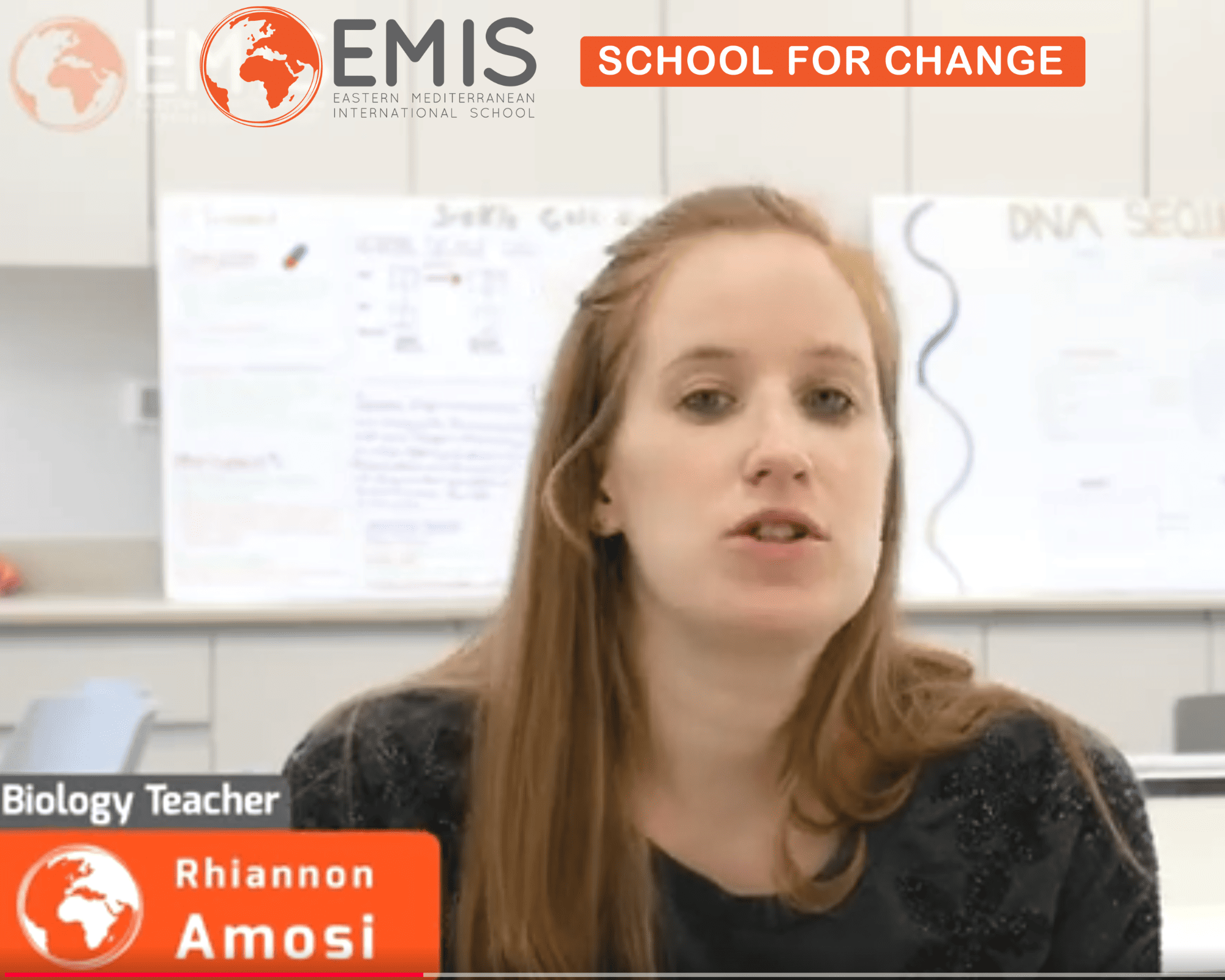
Hear from our teachers